Montréal's three beginnings, Hochelaga, Tiohtiagi, and Ville-Marie
Guest Speaker: Roy Wright
When: Thursday 19 january 2017, from 19h30 to 21h
Where: Centennial Hall
288 Beaconsfield Blvd, Beaconsfield, H9W 4A4
Lecture in English followed by a bilingual question period.
As we celebrate 375 years since the founding of a permanent European settlement at Montréal, we would do well to recall the two previous occasions when French explorers remarked its significance for eventual future settlement, realized in 1642.
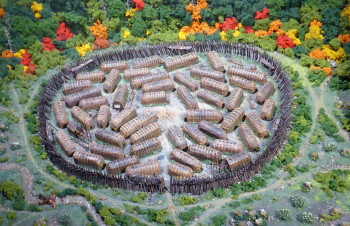
In 1535 Jacques Cartier visited Hochelaga, then as now a centre rivalling the downriver Stadacona settlement at what is now Quebec City. He described it as a community of some 1500 inhabitants surrounded by a palisade, and during his short visit was taken by its chief to the top of nearby Mt. Royal.
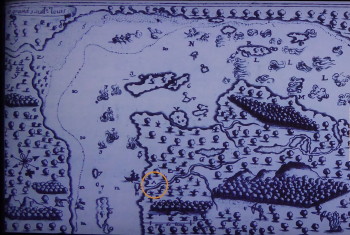 In 1609 and 1611, Samuel de Champlain visited the sites of today's Kahnawake and Montréal (marking the latter with an A on his 1612 map). Here he had to portage around “Sault Saint-Louis”, the Lachine Rapids, noting their importance to the natives gathering to parlay and trade, the former diplomatic function commemorated in the Iroquoian name Tiohtiagi, and the latter commerce still a hallmark of Montréal's importance at the start of the St. Lawrence Seaway.
Finally in 1642, Paul de Chomedy de Maisonneuve, Jeanne Mance and about 50 French settlers started to build a community at the site marked 30 years earlier. The new fortified settlement was named Ville-Marie, in celebration of the religious vision of Sieur de Maisonneuve and Bishop Laval.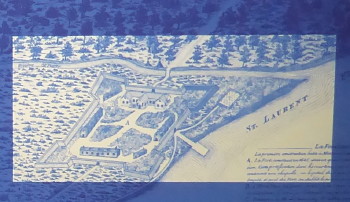
================================================


 We now know that the earthwork tradition is very ancient in this region but that it particularly exploded during two periods. The first explosion occurred about 100 BC and continued to about 400 BC, contemporaneous with the Mediterranean Roman Empire, and the second occurred about 1000 AD and terminated about 1400 AD, paralleling the European Middle Ages. European scholars and archaeologists have proposed many theories about the societies and histories that were responsible for building and using these great earthworks. Many of them are currently rejected by most North American archaeologists and referred to collectively as the Mound Builder mythology.
 Martin Byers was born in Fort William, now Thunderbay, Ontario in 1937 but grew up in Montreal. He graduated from McGill, BA and MA in history/anthropology, gained a PhD in anthropology/archaeology from New York State University at Albany (New York). He taught anthropology and humanities at Vanier College, Montreal, from 1970 to 1998. Martin Byers is a research associate in the Department of Anthropology at McGill University in Montreal, Quebec, Canada. He has authored numerous articles in scholarly journals and has published 3 books.

 Guest speaker: Gérard Leduc

 Guest speaker: Gordon Freeman


 Alexander M. Kim


 Guest Speaker: Daniel Arsenault

